
Long Island Affordability Guide
How Much Income Do You Need to Buy a $700K Home on Long Island in 2026?
With 20% down and little other monthly debt, roughly $140,000–$170,000 may fall within common qualification math. A household income closer to $180,000–$215,000 can provide more breathing room once Long Island taxes and ownership costs are considered.
There is no single salary that guarantees approval for a $700,000 Long Island home. The answer changes with property taxes, credit, down payment, interest rate, homeowners insurance, HOA charges and recurring debts. The useful starting point is the complete monthly housing payment—not price alone.
A 20% down payment example
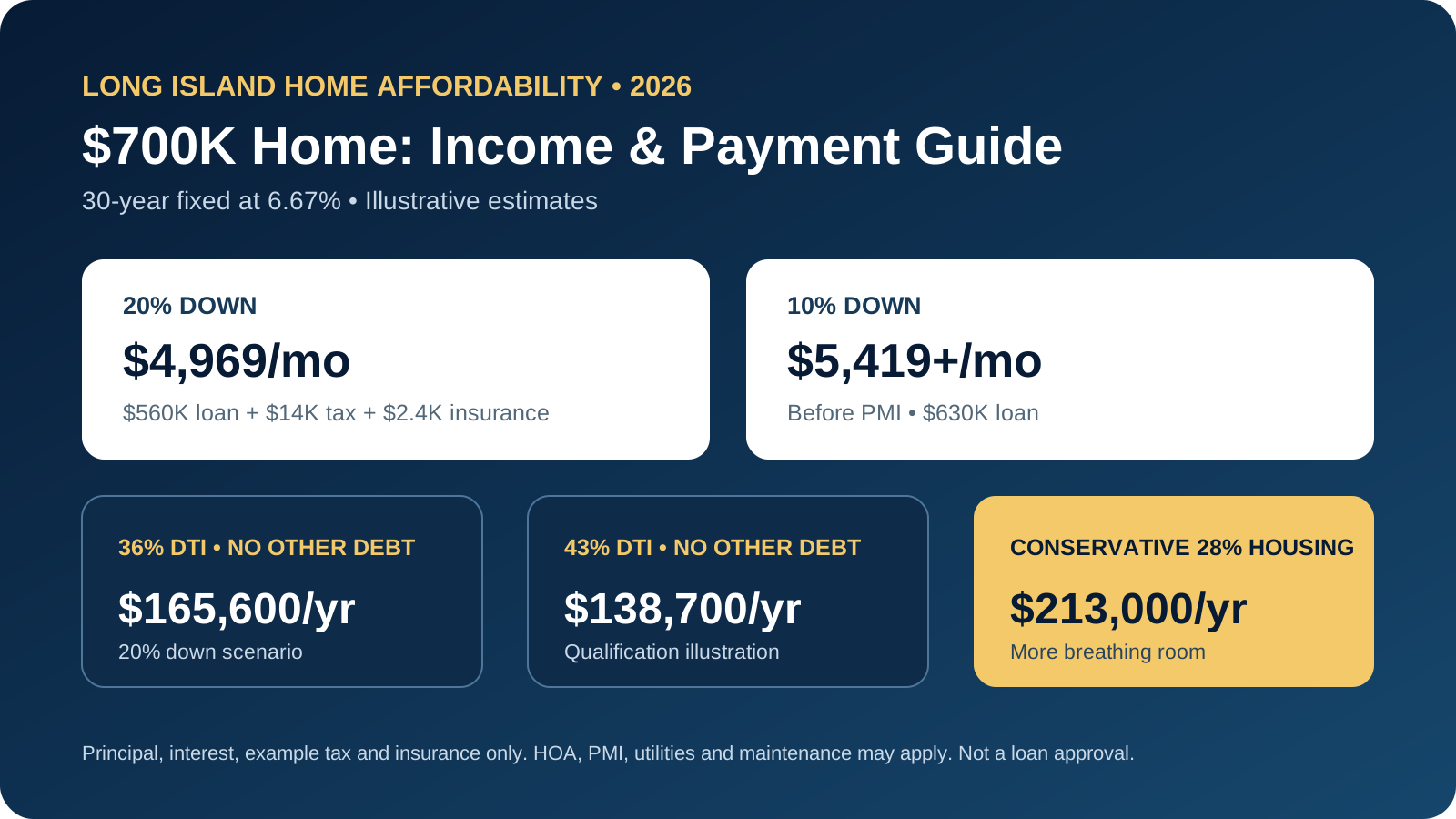
Assume a $700,000 purchase, $140,000 down, a $560,000 30-year fixed mortgage at an illustrative 6.67%, $14,000 in annual property taxes, $2,400 in annual homeowners insurance and no HOA. Principal and interest are approximately $3,602 per month. After the example taxes and insurance, estimated housing cost is about $4,969 per month.
Utilities, repairs, landscaping and maintenance are not included. Property taxes vary substantially by parcel, town, school district, exemptions and assessment, so buyers must verify the actual tax bill for the property.
How DTI changes the income estimate
Lenders compare monthly debt obligations with gross monthly income using debt-to-income ratio, or DTI. If the $4,969 housing payment were the borrower’s only monthly debt, it implies approximately $165,600 of annual income at 36% DTI, or $138,700 at 43% DTI. These are mathematical illustrations, not universal underwriting limits.
Add $1,000 per month for a car loan, student loans and credit-card minimums, and the estimated income becomes about $199,000 at 36% DTI or $166,600 at 43% DTI. Using a conservative 28% housing-only budget produces an income target near $213,000.
What changes with 10% down?
A 10% down payment is $70,000 and leaves a $630,000 loan. At the same illustrative rate, principal and interest are about $4,052 per month. Adding the same taxes and insurance creates an estimated payment of $5,419 before PMI. With no other debt, that corresponds to about $180,600 at 36% DTI or $151,200 at 43% DTI; PMI would raise the required income.
$600K, $700K and $800K payment comparison
At 20% down and 6.67%, principal and interest are approximately $3,088 on a $600,000 home, $3,602 on a $700,000 home and $4,117 on an $800,000 home. Taxes, insurance and HOA must then be added for each property.
Cash to close is more than the down payment
Buyers should also budget for attorney and inspection fees, appraisal, title-related costs, lender charges, prepaid taxes and insurance, and escrow funding. Ask the lender for a written Loan Estimate and estimated cash to close before making a final budget decision.
Practical checklist before touring homes
- Compare same-day Loan Estimates from at least three lenders.
- Review APR, points, lender fees and cash to close—not just the rate.
- Include car, student-loan and credit-card payments in DTI.
- Verify the exact property tax bill and obtain an insurance estimate.
- Keep three to six months of reserves after closing when possible.
- Budget separately for repairs, utilities and routine maintenance.
Bottom line
For a $700,000 Long Island home with 20% down, little other debt may place roughly $140,000–$170,000 within common qualification math. Yet $180,000 or more—and often around $200,000 in household income—can offer a more sustainable margin after taxes, maintenance and reserves. The better question is not only “How much can I be approved for?” but “What payment can I carry comfortably for years?”
Frequently asked questions
Is 20% down required?
No. Loan programs vary, but a smaller down payment increases the loan and may add mortgage insurance.
Does a $140K salary guarantee approval?
No. Credit, debt, reserves, property costs and underwriting determine approval.
Are Long Island property taxes included?
The example uses $14,000 annually; the exact parcel tax must be verified.
This article is general educational information, not mortgage, tax, legal or investment advice. Confirm rates and eligibility with licensed professionals.